Yes — what you’re describing is exactly how people are starting to operationalise this idea in tools like Obsidian.
Here’s how your intuition maps cleanly onto a workable structure:
🧠 How this works conceptually
-
Each node = a page (note)
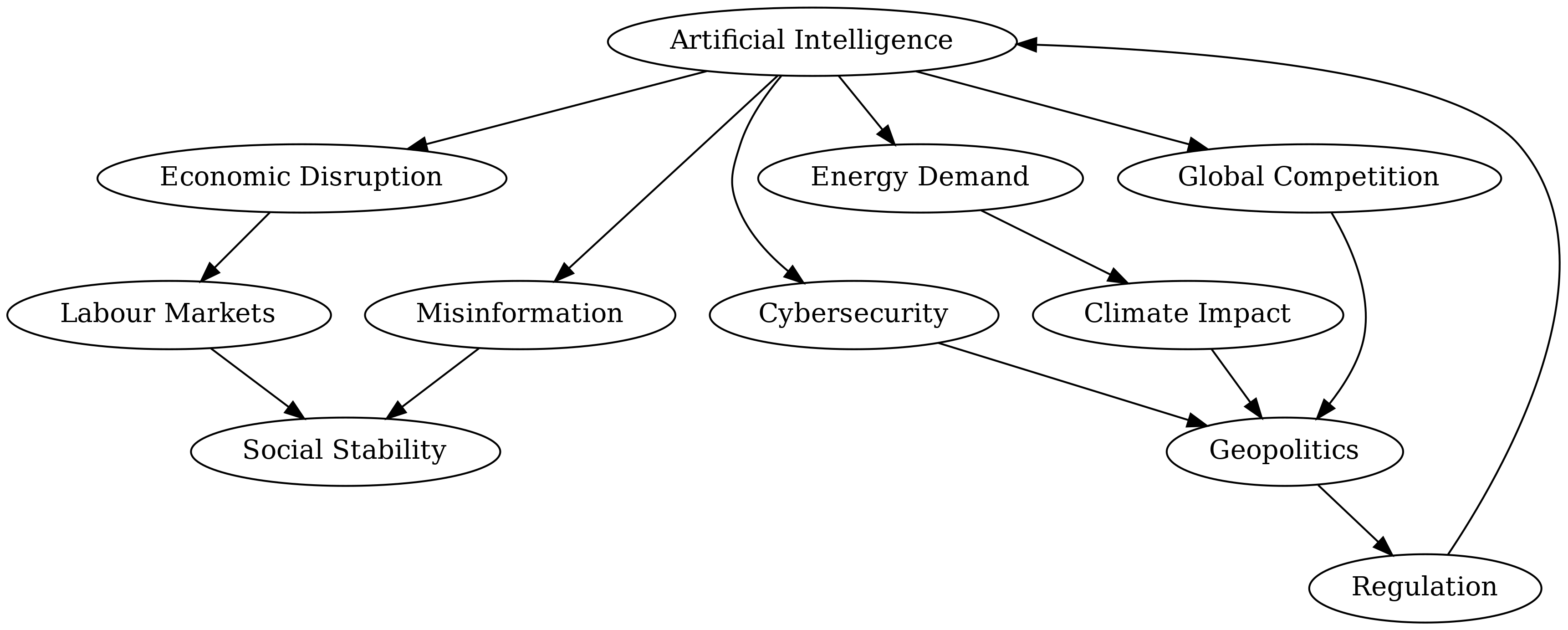
e.g. “Artificial Intelligence”, “Energy Demand”, “Geopolitics” -
Each edge = a link between pages
In Obsidian, this is just[[Energy Demand]]inside the AI page -
The graph view = your polycrisis map Obsidian automatically builds the visual network
📂 How to structure your vault
You don’t actually want just one big page — that becomes messy fast.
Instead:
1. Create a central “hub” page
Call it something like:
AI in the Polycrisis
This page:
- briefly explains the system
- links out to all major domains
2. Each concept gets its own page
Example pages:
- Artificial Intelligence
- Economic Disruption
- Energy Demand
- Misinformation
- Cybersecurity
Inside each page, include:
- short definition
- why it matters
- links to connected concepts
Example (inside “Artificial Intelligence” page):
Links:
[[Economic Disruption]]
[[Misinformation]]
[[Cybersecurity]]
[[Energy Demand]]
[[Global Competition]]
3. Use backlinks as “emergent structure”
The powerful part:
- You don’t manually draw the map
- The structure emerges from connections
This mirrors the polycrisis idea itself:
no central control, just interacting systems
🔁 Why this works especially well
Obsidian vaults naturally support:
- Non-linear thinking (like the polycrisis concept)
- Multiple perspectives (economic, political, technological)
- Evolving structure (you refine links over time)
It’s basically a personal systems model, not just notes.
⚠️ One important constraint
You can make a “master map page,” but:
- It will quickly become outdated
- It forces hierarchy onto something that’s inherently networked
Better approach:
- Keep one index page
- Let the graph view be the real map
🧭 If you want to go further
You can level this up by:
- tagging types of nodes:
#system#risk#actor
- adding “relationship notes”:
- e.g. a page called AI → Labour Markets
This turns your vault into something close to:
a lightweight knowledge graph / systems model
If you want, I can design a starter Obsidian vault structure (folder + page templates) so you can build this without it getting chaotic.