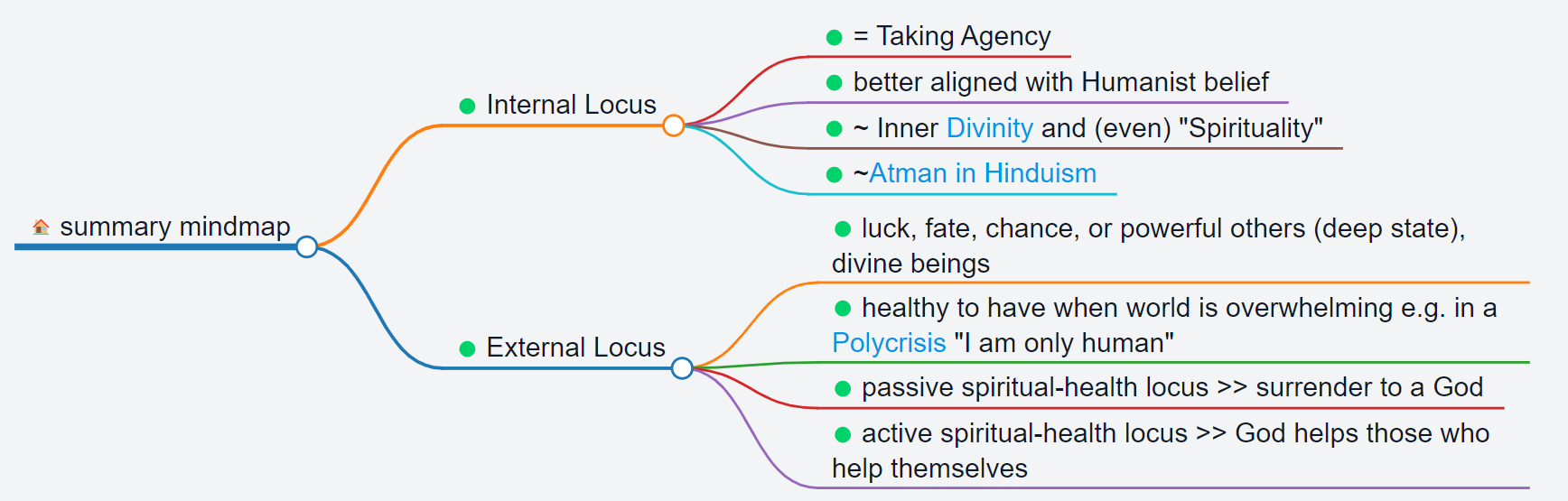
Locus of control in psychology refers to the degree to which individuals believe they have control over events affecting their lives, as opposed to external forces beyond their influence
This concept, developed by Julian B. Rotter in 1954, categorizes beliefs along a spectrum from internal to external
People with an internal locus of control believe that outcomes are primarily the result of their own actions, abilities, and decisions, and they tend to take personal responsibility for their behavior
Research suggests that an internal locus of control is generally associated with higher life satisfaction, greater achievement motivation, lower stress levels, and better coping mechanisms
In Humanism and Jungian perspectives, internalizing locus of control involves reclaiming personal agency and recognizing that while external forces exist, one’s response and growth depend on self-directed action
This aligns with the idea of ” inner divinity ” or inner wisdom—trusting one’s inner guidance while maintaining a relationship with the spiritual or transcendent
Thus, the interplay between internal control and spirituality need not be oppositional; rather, individuals can integrate a sense of personal responsibility with a belief in a higher power or inner sacredness, fostering both autonomy and spiritual connection
In contrast, those with an external locus of control attribute outcomes to external factors such as luck, fate, chance, or powerful others (deep state), including institutional forces or divine beings
However, an external locus of control is not inherently negative and can be adaptive in certain contexts, such as recognizing structural barriers or accepting human limitations
For example, in the face of uncontrollable events, an external orientation may protect self-esteem by reducing self-blame
“I am only human”
** Spirituality ** and religious beliefs often intersect with locus of control.
Belief in God or a higher power can reflect an external locus, particularly when individuals perceive that a divine being governs life events
However, this relationship is nuanced. Some frameworks distinguish between passive and active spiritual-health locus of control:
passive involves leaving outcomes entirely to God, while
active involves a partnership where God empowers individuals to take initiative
Studies indicate that people who believe God is all-powerful yet works with them to manage life events tend to feel more optimistic and report better mental and physical health outcomes